
A Manifesto for Organizational Intelligence That Survives
A Different Question
For centuries, humanity has asked a single question:
How do we preserve knowledge?
We built libraries. We built archives. We built databases. We built clouds.
And yet knowledge continues to disappear.
Engineers retire. Teams reorganize. Projects are abandoned. Companies are acquired. Entire decades of hard-won experience vanish with the people who created it.
The problem is not storage.
The problem is continuity.
Infrastructure Can Already Heal Itself
We have been building self-healing digital infrastructure with OpenKubes.
Git stores the desired state. Kubernetes reconciles reality back to that state. Servers fail. Clusters disappear. Entire environments get rebuilt from scratch — automatically, without human intervention.
Infrastructure survives because it remembers what it should be.
We call this the Immortal Platform.
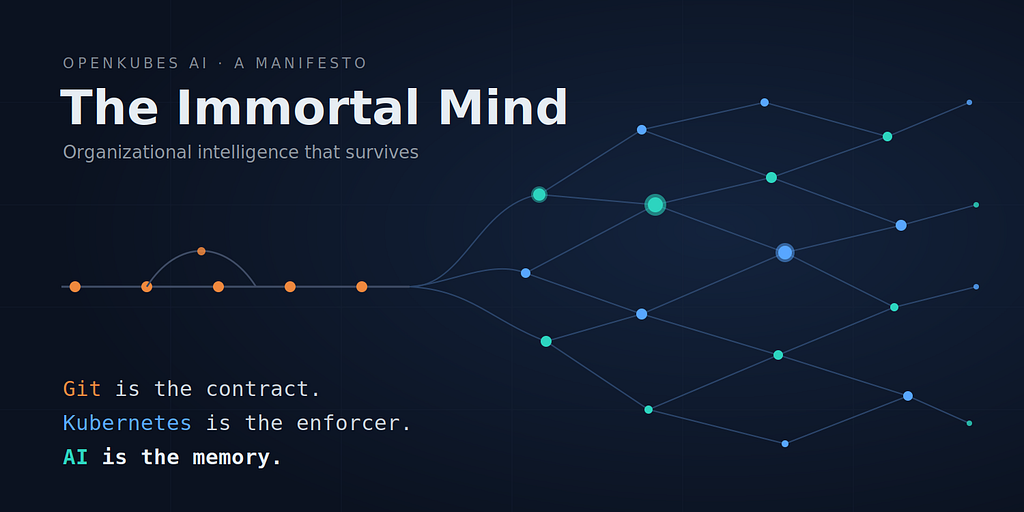
Git is the contract.
Kubernetes is the enforcer.
Target recovery time: under ten minutes. No runbook. No 3am call. No tribal knowledge required.
When we built this, we thought we were solving an infrastructure problem.
We were actually solving the beginning of a much larger problem.
What About Intelligence?
Organizations face a different kind of failure — one that no monitoring system detects, no alert fires for, and no on-call engineer gets paged about.
The slow disappearance of organizational intelligence.
What happens when the engineer who designed the system retires?
Who remembers why that architectural decision was made in 2019?
Who remembers the three failed approaches before the solution that worked?
Who remembers the lessons from the production incident that took down the factory floor for six hours?
Most organizations have no answer.
Their infrastructure is documented. Their intelligence is not.
We have spent ten years building and operating Kubernetes platforms across automotive plants, financial institutions, industrial facilities, and government agencies. We have seen the same pattern repeat itself dozens of times: a new team inherits a platform built by people who are no longer there. They spend months — sometimes years — reverse-engineering decisions that took the original team weeks to make. They repeat mistakes that were already made and documented somewhere no one can find. They abandon patterns that worked because nobody explained why they were there.
The cost is not just time. It is confidence. Every inherited system that lacks its original context becomes a system nobody fully trusts, nobody fully understands, and nobody wants to touch.
This is not a technology problem. This is a memory problem.
The Immortal Mind
OpenKubes AI begins with a simple idea:
Knowledge should be as durable as infrastructure.
The founding principle of OpenKubes is that the platform owns contracts, not components. Infrastructure components come and go — the contracts they fulfill persist. The Immortal Mind extends that same principle to knowledge: decisions, context, and lessons are contracts too. Individual people, teams, and documents come and go — the organizational intelligence they carry must persist.
If we can build infrastructure that heals itself — that reads a desired state from Git, reconciles toward it, and recovers from failure without human intervention — then we can build intelligence systems that do the same.
Not storing documents in a folder that nobody reads.
Not writing runbooks that become outdated before the ink dries.
But genuinely living knowledge — continuously updated, continuously reconciled, continuously connected to the systems and decisions it describes.
Just as Kubernetes reconciles infrastructure to its desired state, future AI systems can continuously reconcile organizational knowledge to its current reality.
Git is the contract.
Kubernetes is the enforcer.
AI is the memory.
To be precise about what we mean: the memory itself does not live inside a model. It lives in Git, in architecture decision records, in the knowledge graph, and in the context that evolves with the platform. AI is what connects, understands, and makes that memory accessible. Models will come and go. The organizational memory must endure.
The Architecture of Organizational Immortality
OpenKubes AI envisions four foundational layers — not as a product announcement, but as an architectural direction:
Layer 1: Knowledge Graph
A structured, living representation of organizational knowledge.
People. Systems. Projects. Decisions. Failures. Lessons. Relationships. Dependencies. Evolution.
Not a static diagram. A continuously updated graph that reflects the current state of the organization and its history — connected to the actual infrastructure it describes.
When a cluster is deployed, the knowledge graph knows why. When an architectural decision is made, it is captured — not in a document folder nobody will find, but in a structured, queryable, AI-accessible form.
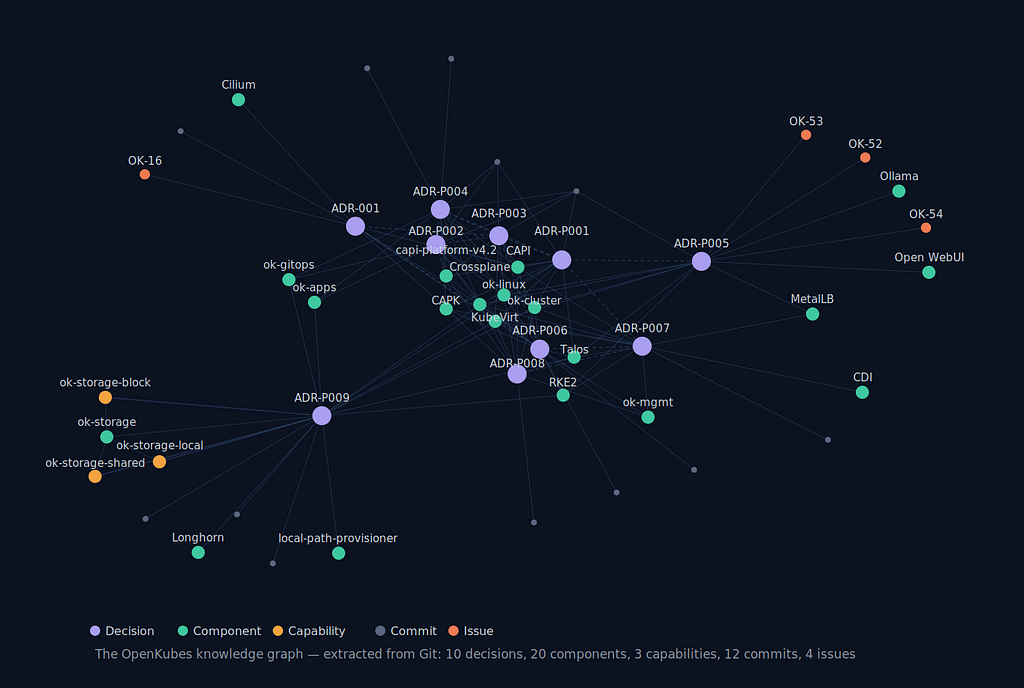
Explore the interactive version: https://kubernauts.de/en/openkubes/openkubes_knowledge_graph_force_layout.html
Layer 2: Context Store
GitOps for knowledge.
Architecture decision records. Runbooks. Postmortem analyses. Design rationale. Lessons learned. Every significant decision — versioned, auditable, and connected to the code and infrastructure it influenced.
Not documentation as an afterthought. Documentation as infrastructure — with the same discipline, the same tooling, the same lifecycle.
When you git blame a Kubernetes manifest, you can trace it back to the incident that caused it. When you ask why a system is designed the way it is, the answer is a git log away.
This is not theory. It is how OpenKubes is already built: every architectural decision lives as a versioned ADR in the platform repository, and every deviation from upstream in our deployment guides is recorded with its reason and its operational impact. The Context Store simply makes that discipline queryable — and permanent.
Layer 3: Model Runtime
Open AI runtimes deployed anywhere — on the same infrastructure that runs your workloads.
Cloud. Edge. Air-gapped factory floors. Sovereign government infrastructure.
The intelligence follows the workload. Not locked in a vendor’s cloud. Not dependent on an external API that may change, disappear, or become unavailable in an air-gapped facility.
The same platform engineering principles that make OpenKubes infrastructure sovereign make OpenKubes AI intelligence sovereign.
Layer 4: Immortal Platform Integration
The platform heals itself. The intelligence remembers itself. The system continuously rebuilds both.
When a cluster fails and is reprovisioned on fresh bare metal, the AI layer knows the history of that cluster — every deployment, every incident, every change. The infrastructure is new. The memory is intact.
Beyond Automation
It is important to say clearly what this is not.
This is not a vision of autonomous machines replacing human engineers.
This is not digital immortality for individuals.
This is not artificial general intelligence.
This is preservation of organizational intelligence.
A future where critical knowledge no longer disappears when individuals leave.
A future where the organization remembers — not just what it built, but why it built it.
The engineer retires. The knowledge stays.
The team disbands. The context remains.
The company is acquired. The intelligence survives.
Why This Matters for Industrial Systems
In a factory, a hospital, a power grid, or a government agency — the stakes of lost knowledge are not measured in developer productivity.
They are measured in production downtime, patient safety, grid stability, and national security.
We have seen what happens when a factory floor loses the engineer who understood the control system. We have seen what happens when a hospital’s IT team inherits infrastructure nobody documented. We have seen what happens when a critical system needs to be rebuilt and nobody remembers the original architecture rationale.
The infrastructure survived. The intelligence did not. The consequences were real.
This is why OpenKubes AI is not a feature.
It is a responsibility.
The Complete Vision
When we look at where OpenKubes is going, we see a platform designed not merely for uptime — but for continuity:
OpenKubes IMP → Infrastructure survives
OpenKubes AI → Knowledge survives
OpenKubes Robotics → Actions survive
The Robotics layer is not hypothetical. Open-RMF — the open robotics middleware framework for fleet management, traffic coordination, task dispatching, and simulation — runs today as a reference robotics workload on the OpenKubes platform, deployed through the same GitOps-based operational model as everything else, consistently across local, edge, bare-metal, and public cloud environments.
Together these layers form something that has never existed before:
A platform where systems, knowledge, and actions persist — regardless of hardware failures, software updates, team changes, or the passage of time.
Infrastructure that heals itself. Intelligence that remembers itself. Systems that evolve themselves.
An Invitation
This manifesto is not a product announcement.
It is a direction.
OpenKubes AI does not exist yet as a shipping product. But the architectural foundation does — in the Git repositories, the Crossplane compositions, the Cluster API providers, the running robotics reference workload, and the knowledge accumulated across ten years of building and operating critical Kubernetes infrastructure.
The Immortal Mind is where that foundation leads.
If you are building systems that cannot afford to forget — factory automation platforms, critical infrastructure, sovereign AI systems, industrial knowledge management — we want to build this with you.
Not for you. With you.
Because the most important knowledge to preserve is the knowledge we build together.
Git is the contract. Kubernetes is the enforcer. AI is the memory.
Together, they create systems that do not merely survive failure. They learn from it.
🔗 github.com/openkubes/openkubes 📊 OpenKubes Platform Presentation 📖 blog.kubernauts.io 🎯 OpenKubes Roadmap: OK-30 Immortal Platform
Arash Kaffamanesh is the founder of Clouds Sky GmbH & Kubernauts GmbH and has been building and operating Kubernetes platforms for over ten years across automotive, industrial, financial, and healthcare environments. He is the creator of OpenKubes — the open platform for self-healing sovereign Kubernetes infrastructure.
The Immortal Mind was originally published in Kubernauts on Medium, where people are continuing the conversation by highlighting and responding to this story.
Mehr zu Kubernetes Services, Kubernetes Training und Rancher dedicated as a Service lesen unter https://blog.kubernauts.io/the-immortal-mind-d960cc83c065?source=rss—-d831ce817894—4
Ask the Kubernauts for Rancher Pricing, Rancher Support and Rancher Enterprise Level Packages.
Neueste Kommentare